The Future of Growth-Drive Technology: From Analysis to Command
 George Sandmann, Founder: Oct 9, 2026, 12:14:23 PM
Something extraordinary is happening at Growth-Drive. And I want to give you a glimpse of where we’re headed.
The 85+ Strategic Capacity Asset Class represents businesses that operate at institutional quality — companies scoring 85 or higher in total Strategic Capacity. These enterprises are:
They are not merely “well-run.”
They are durable, scalable, and transaction-ready — whether they ever transact or not.
And at the center of this asset class sits an executive whose role is often misunderstood: the CFO.
In sub-70 businesses, the CFO is typically a historian.
In 70–84 businesses, the CFO is a competent financial manager.
In 85+ businesses, the CFO performs three integrated roles that determine whether the enterprise qualifies as an asset — or remains a job.
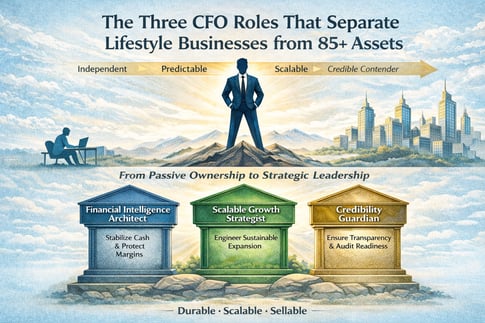
(Predictable Profits & Cash Flow)
An 85+ business cannot exist without visibility.
The first role of the CFO is to build financial intelligence infrastructure:
This is not bookkeeping.
It is the operating dashboard of the enterprise.
Without timely and accurate reporting:
With disciplined financial intelligence:
Predictability begins with visibility.
The 85+ threshold requires financial reporting that is timely, accurate, and decision-ready — not retrospective and reactive.
This is the launchpad.
(Predictable Sustainable Growth)
Growth without financial architecture is fragility disguised as ambition.
The second role of the CFO is to function as capital strategist.
An 85+ enterprise does not grow recklessly.
It grows intentionally.
The CFO must continuously answer:
Budgeting and forecasting are not accounting exercises.
They are capital allocation strategies.
In lower-capacity businesses, budgets are often optimistic projections.
In 85+ businesses:
This is where many otherwise strong companies fail to cross the 85 threshold.
They may grow revenue.
They may even grow profit.
But they do not grow predictably.
Institutional capital demands predictability.
The CFO’s capital strategy role transforms growth from aspiration into engineered scalability.
(Predictable Transferable Value)
The third role is the one most directly tied to valuation.
Transferable value depends on buyer confidence.
Confidence depends on credibility.
An 85+ Strategic Capacity enterprise must demonstrate:
In due diligence, credibility either compounds value — or destroys it.
If financial reporting lacks discipline:
If reporting is credible and consistent:
In the 85+ Asset Class, the CFO does not “prepare the company for sale.”
The CFO builds a company that is always sale-ready — even if it never sells.
That optionality is strategic power.
A company may excel in reporting but lack capital strategy.
It may grow aggressively but lack credible financial controls.
It may be audit-ready but lack operational intelligence.
It does not qualify as an 85+ asset unless all three roles operate simultaneously.
|
CFO Role |
Strategic Impact |
Asset-Class Effect |
|
Financial Intelligence |
Operational predictability |
Margin defense & control |
|
Capital Strategy |
Scalable growth |
Reduced fragility |
|
Credibility & Compliance |
Transferable value |
Premium valuation |
These roles map directly to the three dimensions of business growth:
The CFO is central to all three.
This is not an accounting function.
It is institutional architecture.
The market is beginning to bifurcate.
Businesses below 70 struggle with operational chaos and fragile growth.
Businesses between 70–84 can transact — but often on discounted terms or with onerous structures.
Businesses at 85+ command attention.
They operate independently of the founder.
They attract capital.
They complete transactions cleanly.
They retain optionality.
The difference is not charisma.
It is Strategic Capacity.
And in that equation, the CFO is not support staff.
The CFO is either:
or
Maximized transferable value is the ultimate measure of business success.
But transferable value does not begin at the deal table.
It begins in the CFO’s office.
The companies that cross the 85+ threshold do not accidentally become institutional-quality assets.
They are engineered that way.
And the CFO is foundational to that engineering.
 George Sandmann, Founder: Oct 9, 2026, 12:14:23 PM
Something extraordinary is happening at Growth-Drive. And I want to give you a glimpse of where we’re headed.
 George Sandmann, Founder: Sep 3, 2026, 9:55:18 AM
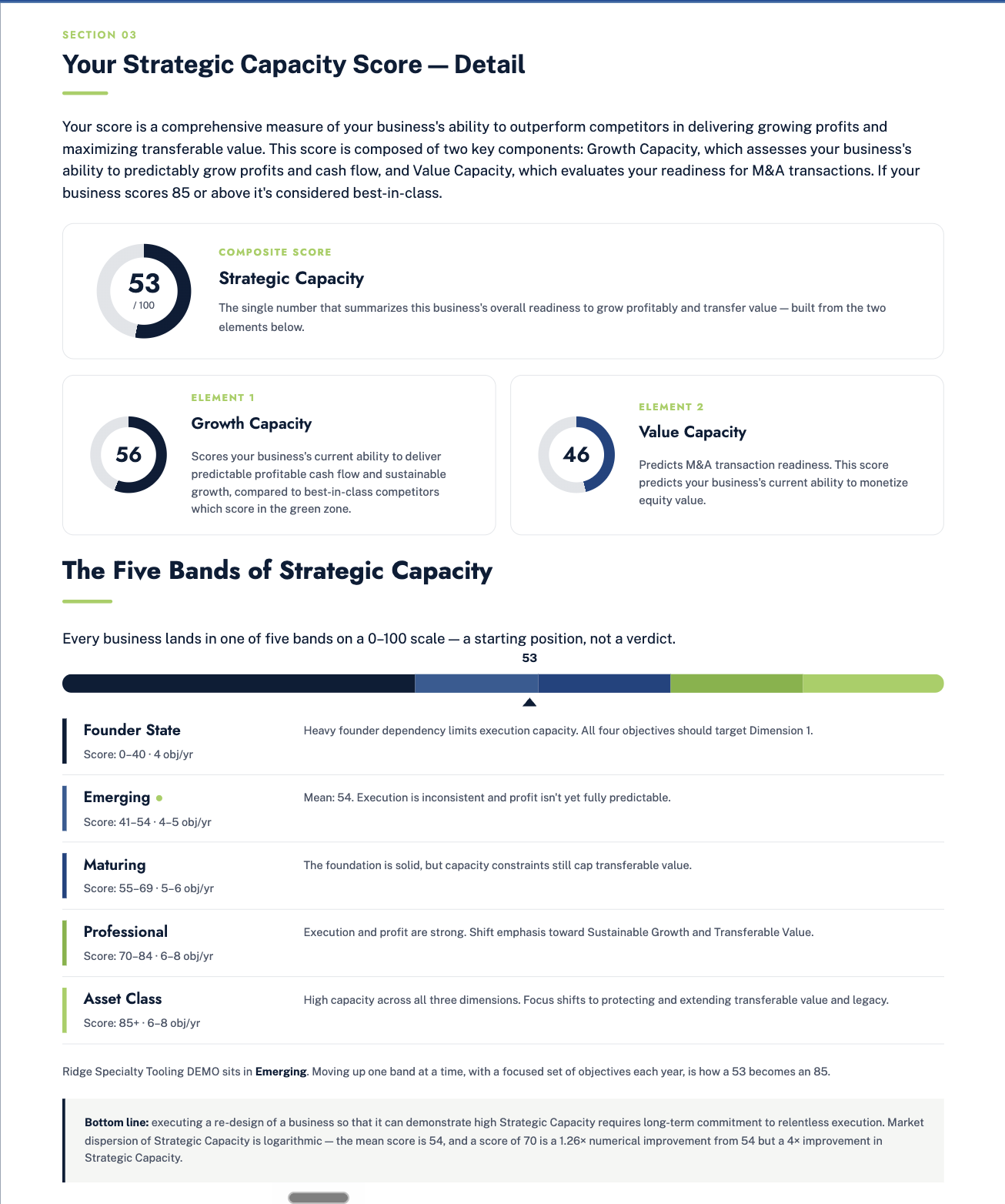
For years, we have described Strategic Capacity as a business's ability to predictably and sustainably grow profits and cash flow. That definition...
 George Sandmann, Founder: Aug 28, 2026, 2:59:21 PM
Advising a business owner is about the best work we can do. The owner’s business is often their largest asset, primary source of income, greatest...