Tim Cook had a rule at Apple: Three sentences. Every meeting. “Before any discussion begins, the meeting opener must state three specific points to ensure clarity and focus. The decision we're making; what happens if we’re wrong; who owns the outcome.”
This tracks directly to Growth-Drive’s Execution Leadership Business Operating System: Leadership Accountability to Strategic Capacity. Why? Because clarity beats conversation.
In high-value businesses:
• Leaders own outcomes
• Progress is measurable
• Decisions turn into action
If you can’t say:
1️⃣ What you own
2️⃣ What moved this week
3️⃣ What happens next
— you’re not leading, you’re talking.
Real accountability isn’t louder. It’s clearer. And it’s how businesses become valuable without the founder in the room.
Race-Pace Leadership is Not About Speed
Race-Pace Leadership is not about speed. It is about efficiency.
It is about sustained execution at a level the business can maintain.
In private companies, leadership failure rarely comes from a lack of intelligence, effort, or ambition.
It comes from inconsistency.
From bursts of activity followed by stalls.
From meetings that feel productive but fail to move the business forward.
Race-Pace Leadership exists to eliminate that failure mode.
We Believe
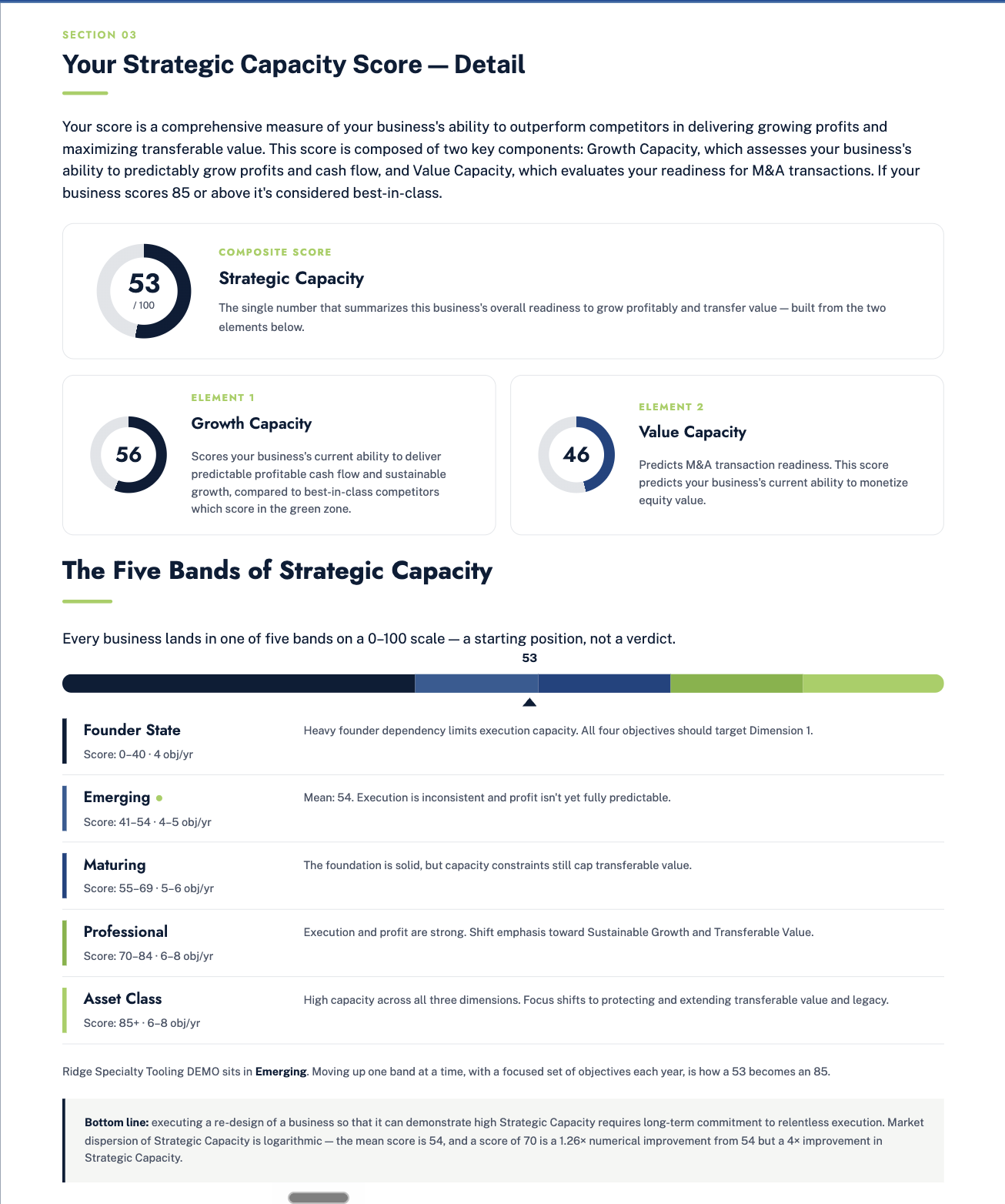
A business is only as strong as its Strategic Capacity—its ability to deliver predictable profits, sustainable growth, and transferable value independent of any one individual.
Leadership, therefore, is not defined by presence, personality, or heroics.
Leadership is defined by what moves, how predictably it moves, and whether it keeps moving without the CEO pushing from behind.
The discipline of Race-Pace Leadership makes this possible.
Race-Pace Leaders Own Outcomes, Not Activity
Race-Pace Leaders do not hide behind effort, busyness, or intent.
They are accountable to specific growth-driving objectives.
They know:
- What they own
- Why it matters
- How success is measured
If an objective is not moving, leadership is not occurring—regardless of how hard someone is working.
Race-Pace Leaders Measure Progress Relentlessly
Race pace is not judged by stories.
It is judged by lap times.
Race-Pace Leaders can point to:
- A KPI that moved
- A variance that narrowed
- A bottleneck that was removed
They understand that what cannot be measured cannot be trusted—and what cannot be trusted cannot be scaled or sold.
Race-Pace Leaders Decide and Commit
Momentum is lost not by bad decisions, but by undecided leadership.
Race-Pace Leaders:
- Make decisions with the data available
- Commit to next actions
- Keep the business in gear
They understand that indecision is a tax on growth and a drag on value.
Race-Pace Leadership Is Sustainable by Design
Sprint leadership burns people out.
Hero leadership creates dependency.
Both destroy transferable value.
Race-Pace Leadership is built for endurance.
It sets a tempo the organization can sustain:
- Week after week
- Quarter after quarter
- Without extraordinary effort
This is how businesses become easier to run—and best-in-class.
Race-Pace Leadership Applies to All
Imagine a team where only one person is operating at Race-Pace.
Now imagine a team - the driver, pit crew, strategist, coaches, everyone - operating at race-pace. You immediately see which team is likely to outperform, to win.
Race-Pace applies to all.
Senior leaders operate using race-pace.
Their direct reports operate using race-pace. And all teams, employees and contractors from the C-Suite to the shop floor operate at Race-Pace.
The weekly SLT meetings, team meetings, and daily huddles focus on race-pace principles.
Race-pace is the culture DNA
Race-Pace is Constant But Not Unrelenting
As in F1, NASCAR and Rally: Race-Pace recognizes the need for pit stops.
Unrelenting pace causes breaks, errors, friction and burnout. Unrelenting is inefficient.
Pit stops manifest in the Growth-Drive methodology and process. In the Analyze-Design-Execute action cycle, Race-Pace applies to Execute.
The team pauses periodically to analyze progress and true up the design (plan).
A quarter is 13 weeks. Ten weeks are committed to Race-Pace Leadership Execution; three weeks are reserved as pit stops for analysis, re-design and provide time to catch up on inevitable execution delays.
Race-Pace is effective and efficient, and sustainable.
Race-Pace Leadership Reduces Risk and Increases Value
The private capital markets —buyers, lenders, and investors— are not betting on charisma.
They are betting on predictability.
Race-Pace Leadership:
- Reduces key-person risk
- Increases execution confidence
- Makes future performance more believable than past performance
This belief, this confidence in predictability of performance drives multiples.
Our Standard
A Race-Pace Leader can answer—clearly and concisely—every week:
- What growth-driving objective do I own, and is it moving at race pace?
- What measurable result proves progress this week?
- What decision or action am I committing to next to maintain pace?
If those answers are not clear, leadership is not happening yet.
The Commitment
Race-Pace Leadership is not a mindset.
It is not a slogan.
It is not a meeting technique.
It is a behavioral standard.
One that transforms strategy into execution,
Execution into market confidence,
And confidence into transferable business value.
This is how private companies stop relying on founders,
Start relying on systems,
And become best-in-class.
 George Sandmann, Founder: Sep 3, 2026, 9:55:18 AM