The Future of Growth-Drive Technology: From Analysis to Command
 George Sandmann, Founder: Oct 9, 2026, 12:14:23 PM
Something extraordinary is happening at Growth-Drive. And I want to give you a glimpse of where we’re headed.
We all work at attracting new and loyal customers and growing our businesses, right? Of course we do - data tells us this is 83% of our peers. Why? Because this is the sure path to building wealth and legacy.
Here’s the thing. None of your customers care about your wealth. What do they care about? They care about how your business helps their community. They care about your impact. They may not care about your personal wealth, but they sure care about your legacy.
Say it out loud: “People don’t care about what the business does for me, they care about what we do for them.” This truth can set you free.
→ Embrace this reality and transform your business. Makers create more value than they extract. Takers don’t.
→ By creating a maker-not-taker vision statement, you are creating a guiding star proven to lead you as you out-perform your competitors.
“It’s all about impact. Effective business vision is larger than the business itself. It’s not just about profit—it’s about contribution.”
"Businesses with revenues between $2.5 million and $100 million are the backbone of the U.S. economy—generating over $10 trillion annually, nearly a third of the nation's GDP. Now imagine this powerful engine not just creating wealth, but democratizing 'good'—scaling opportunity, innovation, and resilience across every community they touch.”
— George Sandmann, Growth-Drive, December 2025
In a world where vision statements are often treated as mere marketing fluff, the “Maker-not-Taker Philosophy” reframes what it means to lead and build a business. Considering one of the Growth-Drive community’s guiding principles “We are Net Givers” and inspired by Elon Musk’s concept of makers vs. takers, the idea is simple:
There is an implied judgement here, but there should not be. We do not argue that every organization must be a net giver, a ‘maker’.
No. We do however argue that by observing the market, we can conclude that a maker-inspired vision delivers wins. Here we are merely highlighting a proven philosophy found in businesses with top Strategic Capacity. It is a philosophy analyzed and supported in our methodology and in the CLARITY™ software. By applying a ‘maker’ mindset, leaders shift from extractive thinking to their own value-creating strategy. According to the Growth-Drive methodology, the most powerful visions are anchored in this philosophy, giving them far more horsepower to drive alignment, growth, and impact.
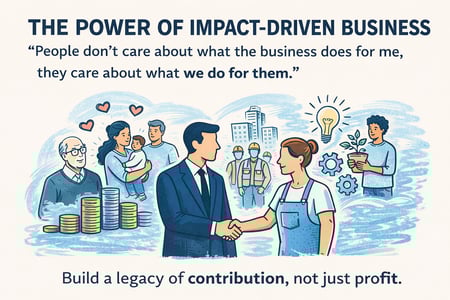
Unlike a traditional vision statement that describes a distant future, a Maker Vision Statement acts as your north star—a deeply personal, value-driven commitment to impact. It sits above financial goals but fuels them through purpose.
Example:
“Our vision is to help $1 trillion of private businesses increase strategic capacity across three dimensions of growth.”
— Growth-Drive Vision
Most vision statements fail to resonate because:
Two key elements from the Growth-Drive methodology help translate a high-level vision into executable strategy: Strategic Intent and Guiding Principles. These components serve as the bridge between aspiration and action—clarifying where the business is going, and how it will behave on the journey.
Together, these help translate your vision into execution. For example:
 George Sandmann, Founder: Oct 9, 2026, 12:14:23 PM
Something extraordinary is happening at Growth-Drive. And I want to give you a glimpse of where we’re headed.
 George Sandmann, Founder: Sep 3, 2026, 9:55:18 AM
For years, we have described Strategic Capacity as a business's ability to predictably and sustainably grow profits and cash flow. That definition...
 George Sandmann, Founder: Aug 28, 2026, 2:59:21 PM
Advising a business owner is about the best work we can do. The owner’s business is often their largest asset, primary source of income, greatest...