The Future of Growth-Drive Technology: From Analysis to Command
 George Sandmann, Founder: Oct 9, 2026, 12:14:23 PM
Something extraordinary is happening at Growth-Drive. And I want to give you a glimpse of where we’re headed.
I'll be leading a hands-on roundtable on advisor business development at the EPI Summit in Nashville — specifically how to use the Integrated Strategic Capacity Doctrine to win better clients, build deeper referral relationships, and command a fundamentally different kind of advisory practice. If that's the conversation you need, reserve your spot here.
Ask a room full of exit planners and growth-driving advisors what their biggest challenge is, and the answer is almost never the quality of their advice. It's their sales pipeline. #mikegarrison.

The struggle? Getting in front of the right business owners. Converting introductions into engagements. Building referral relationships with like-minded advisors that actually produce — not just business cards exchanged at conferences. Differentiating in a market where every advisor claims to help business owners grow and exit successfully.
These are the real constraints on most advisory practices. And they persist not because advisors lack skills, but because most advisory frameworks give you nothing truly differentiated to bring to the first conversation.
This changes with the Integrated Strategic Capacity Doctrine.
What I want to argue here — and what we'll be workshopping in Nashville — is that the doctrine is not just a methodology for helping clients. It is, properly understood, the most powerful business development system available to a private business advisor.* It gives you a language that resonates with every business owner regardless of their stated intent. It gives you a measurement that creates accountability where there was none. It gives you a referral value proposition that wealth advisors, investment bankers, and CPAs have never seen before. And it gives you a client relationship that compounds over years rather than closing at a transaction.
Let's walk through exactly how.
*Looking to master these skills? Ping Mike Garrison at The Strategic Referral Team - he’ll be in Nashville.
Business development starts with a problem worth solving. The Integrated Strategic Capacity Doctrine hands you the most consequential problem in private business: the catastrophic structural gap between what most business owners believe their company is worth and what the market will actually pay.
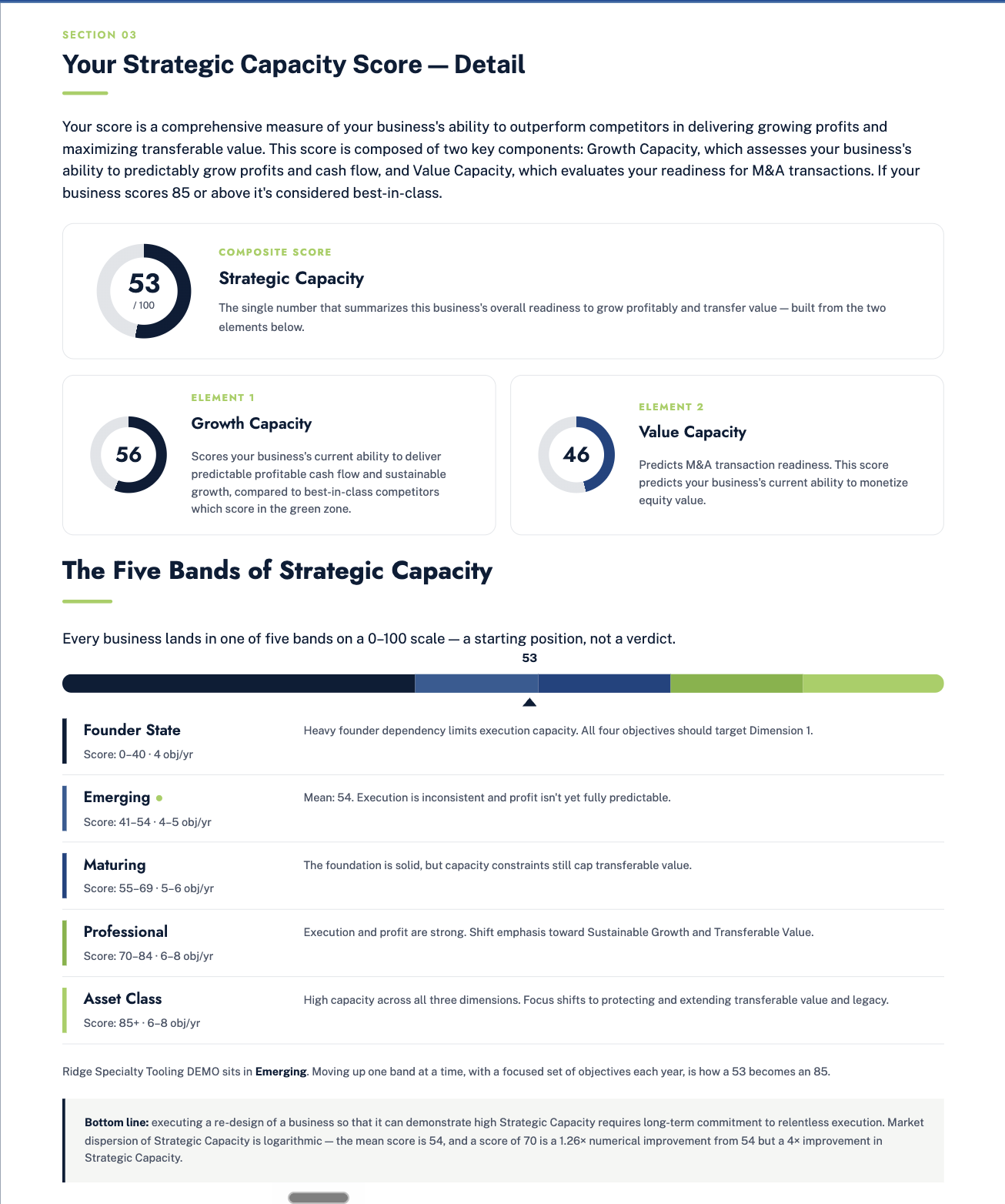
The data is precise. The average private business scores 54.1 when analyzed using the CLARITY™ Strategic Capacity infrastructure. Fewer than 20% score 70 or above. Only about 5% of businesses ever cross the 85-point threshold that qualifies them as a genuine, transferable institutional asset — what we call the 85+ Strategic Capacity Asset Class™. That means roughly 95% of the private businesses in your market are structurally underperforming relative to what their owners expect and deserve.
These businesses are not failing. They are generating revenue. Many are generating significant revenue. But they have not been built with the architecture that separates a cash-flow-dependent job from a genuine, transferable asset. Their value is personal, not institutional — inseparable from the founder's energy, relationships, and judgment. And when these businesses enter an M&A process, face succession, seek institutional capital, or simply want to grow without breaking, they discover their limitations too late. Buyers discount them aggressively. Deals collapse or never happen at all.
This is the problem your practice exists to solve. The question is whether you can surface it — credibly, data-driven, and early enough to matter — before the transaction table makes the conversation too late.
The doctrine gives you exactly that capability.
One of the most powerful things about the Integrated Strategic Capacity Doctrine from a business development standpoint is that it maps perfectly onto the actual distribution of business owner intent.
When you sit across from a prospective client for the first time, their stated objective falls into one of three categories. About 21% primarily want to make the business easier to run — they are exhausted by founder dependency and want their lives back. About 62% want to grow — they want more revenue, more profit, a bigger enterprise. And about 17% are focused on a near-term liquidity event — they want to sell, recapitalize, or transition.
Most advisory frameworks are optimized for one of these. Exit planners are built for the 17%. Growth consultants are built for the 62%. Business coaches are built for the 21%. This means the majority of advisors are irrelevant to the majority of their prospective clients — at least as framed.
The doctrine dissolves that limitation entirely. Because Strategic Capacity is the measurable foundation of all three outcomes, you are relevant to every owner regardless of where they sit today. The business that wants to be easier to run needs reduced key-person dependency — that's Dimension 1 work. The business that wants to grow needs scalable systems and documented processes — that's Dimension 1 and 2. The business that wants to sell needs to be acquisition-ready — that's all three dimensions simultaneously. And crucially, all three paths converge at the same destination: the 85+ Strategic Capacity Asset Class™.
This means your BD pitch is never "I help businesses exit" or "I help businesses grow." It is something far more powerful: "I help businesses become genuinely excellent — predictable, scalable, and transferable — and I can measure exactly where yours stands right now." This opens a conversation with virtually every business owner in your market.
The doctrine alone is a philosophy. CLARITY™ is what makes it actionable — including in your very first client conversation.
The CLARITY™ Strategic Capacity Analysis is the advisor's most powerful business development tool, full stop. Here's why: it transforms an introductory meeting from a pitch into a discovery event. Instead of telling a prospective client what you do, you show them exactly where their business stands — scored against institutional best-in-class standards, benchmarked against their industry, and translated into a precise dollar calculation of their current transferable value versus the value trapped by low Strategic Capacity.
That trapped value number is where the conversation changes. Most business owners have never seen their business evaluated this way. They know their revenue. They have a rough sense of EBITDA. They may have gotten an informal opinion of value from a banker at a cocktail party. But they have never seen a score across 24 specific growth-driving objectives, with a dollar figure attached to each gap, and a projection of what closing that gap would mean for their equity value over three to five years.
When you present that data, you are not selling. You are measuring. And measurements, unlike pitches, create accountability — the kind of accountability that motivates real change and real engagements.
The CLARITY™ Level 1 analysis can be run quickly enough to use in CEO workshop marketing events — a format that has proven extraordinarily effective for advisor business development. Imagine bringing together a room of 8–12 business owners, co-hosted with a wealth advisor or fractional CFO who shares your target client profile. Each of you brings your existing relationships to the room. Together, you walk prospects through a Strategic Capacity analysis, surface the gap between their current transferable value and what their business could be worth, and introduce the Equity Value Planner to connect that gap to their personal wealth goals. Every advisor in the room demonstrates expertise. Every business owner in the room sees their situation with new eyes. And every follow-up conversation starts from a foundation of data rather than a sales pitch.
Advisors who run these events consistently do not just do one. They become the engine of their practice.
For most exit planners and growth advisors, referral development is the hardest and most frustrating part of building a practice. You know that wealth advisors, investment bankers, and CPAs are touching your ideal clients every day. You know that those professionals, in theory, should want to refer business owners to you. But in practice, the referrals don't come — or they come sporadically, without structure, and almost never compound into the kind of strategic collaborative relationship that actually drives a practice.
Why? Because most business advisors have not given their potential referral partners a compelling reason to send clients their way — and when they do get a referral, they often fail to close the loop in ways that reinforce the relationship. But the biggest sin? Business advisors rarely reciprocate. They are happy to get referrals, yet they never give them.
The doctrine changes both sides of this equation.
From the wealth advisor's perspective, a business-owning client is the most valuable relationship in their book. A business owner with even $10 million in enterprise value represents not just the immediate AUM from their personal accounts, and the eventual management of the liquidity event proceeds — which can be a transformational event for the advisor's practice. The reality is that business advisors can uncover advanced wealth planning, sophisticated compensation planning, succession planning and insurance product opportunities at the front end of the engagement. Imagine how a wealth advisor will feel when you drop immediate revenue opportunities on their desk every time you meet a new client. Do you think this will cement relationships? This is good for the advisor, and great for the client.
Let’s look at transferable value, that great contributor to wealth. The problem is that most wealth advisors have no structured way to help that client build the business to the point where the transaction actually occurs, on the terms the client expects. They want to help. They are not equipped to -and many times are forbidden to.
The advisor who walks into that wealth advisor's office with CLARITY™ and says, "I can measure your client's transferable value today, identify the gap, and build a multi-year plan to close it — so that when the transaction happens, the value is there… and oh-by-the-way here are planning and insurance opportunities for you…" is offering something no other business advisor has offered before. Not a vague promise to help the business grow or for AUM down the road. Growth-Drivers roll up to the pole with a measurement, a target, and a structured process — with the wealth advisor positioned as the architect of a coordinated advisory team.
Investment bankers are equally powerful referral sources, and equally underserved by most business advisors. Investment bankers pass on a significant majority of the deals that come across their desks — not because the businesses aren't interesting, but because those businesses do not have the Strategic Capacity to successfully complete a transaction. They lack the financial reporting discipline. The key-person risk is too high. The customer concentration is disqualifying. The banker passes, and the business owner goes home disappointed — often without understanding why.
The Growth-Drive advisor who has built a relationship with that investment banker is positioned as the person who takes those passed-on companies and builds them into qualified deals. "When they're ready, send them back to me" is an extraordinarily compelling offer — because you have a defined, measurable standard for what "ready" means, and a proven process for getting them there. That is not a vague referral relationship. That is a structural pipeline.
There is a meaningful difference between a referral and a strategic collaborative relationship — and understanding that difference is central to building a sustainable advisory practice.
A referral is a transaction. One advisor sends a client to another, and the receiving advisor executes in their lane. A strategic collaboration is an ongoing, structured partnership where two or more advisors coordinate continuously around a shared client's progress — with defined roles, explicit communication agreements, and mutual accountability for outcomes.
Strategic collaborations are harder to build. But they are also far more durable, far more productive, and far more satisfying for every party involved — including the client. Business owners who are served by a coordinated advisory team experience faster progress, fewer gaps, and greater confidence that their situation is being managed comprehensively. They don't want to repeat themselves to four different advisors. They don't want to manage the coordination themselves. When that burden is lifted — when a business advisor and a wealth advisor and a tax advisor are operating in a structured, communicative team — the client notices, and they stay.
The doctrine is the natural organizing principle for these collaborative teams. Because Strategic Capacity spans all three dimensions of a business's performance — operational, growth, and transferable value — it provides a common language and a common measurement standard that every advisor on the team can anchor to. The wealth advisor knows the equity value target. The CPA knows the financial reporting standards required to reach it. The business advisor knows the operational objectives that must be achieved. Everyone is working from the same score, the same roadmap, and the same client intent.
That is what collaborative accountability looks like — and it is what separates the advisors who build lasting, compounding practices from those who chase the next referral indefinitely.
Here is the BD flywheel that the doctrine creates, once you understand how to use it:
You run a CLARITY™ analysis with a prospective client — either directly or through a CEO workshop event. The analysis surfaces a Strategic Capacity score, a calculation of trapped value, and a multi-year projection of what closing the gap would mean for the business's equity value and the owner's personal wealth. The owner sees their situation clearly, perhaps for the first time. A meaningful engagement begins.
As the engagement progresses across the Analyze-Design-Execute cycle, you are coordinating with a wealth advisor who is monitoring the AUM implications of rising transferable value, a CPA who is reorienting financial reporting from tax minimization to capital markets readiness, and potentially an investment banker who is tracking the business toward transaction qualification. Each of those advisors sees you deliver — sees you move the score, watches the trapped value convert into transferable value, and observes the client's confidence grow. Trust compounds. Referrals follow. And the next CEO workshop has a broader co-host network and a warmer room.
Meanwhile, the client relationship itself extends far beyond any single engagement phase. The 85+ Strategic Capacity Asset Class™ is a multi-year destination. The Growth-Drive execution operating system, once installed, creates an ongoing advisory relationship that is embedded in the business's day-to-day rhythm. The advisor is not a project that ends — they are a fixture in the leadership cadence, reviewing scores, updating the strategic plan, tracking progress against the 24 growth-driving objectives. That is a retainer relationship, not a project fee. And it is a relationship that generates referrals to the advisor's network continuously, because every business owner who succeeds becomes a champion for the person who helped them get there.
At the EPI Summit in Nashville, I'm going to be leading a working roundtable on exactly this — not theory, but practice. We'll work through how to position yourself as an irreplaceable COI to wealth advisors and investment bankers, and how to build the collaborative team structures that create compounding referral pipelines rather than one-off introductions.
If you are an exit planner who is tired of arriving too late to the transaction. If you are a growth advisor who wants to connect your operational work to a quantified equity value outcome. If you are a wealth advisor who wants a structured way to help business-owning clients build the asset that will define their wealth — this roundtable is for you.
The Integrated Strategic Capacity Doctrine is not just a better way to serve clients. It is a better way to build a practice. Come find out how.
Reserve your spot at the Nashville roundtable here.
George Sandmann is the Founder & CEO of Growth-Drive and the author of The Growth-Driving Advisor (Forbes Books, 2023). Growth-Drive trains and equips business advisors, exit planners, and wealth professionals to lead private business owners to the 85+ Strategic Capacity Asset Class™ through the CLARITY™ platform and C3D Certification program. Learn more at growth-drive.com.
 George Sandmann, Founder: Oct 9, 2026, 12:14:23 PM
Something extraordinary is happening at Growth-Drive. And I want to give you a glimpse of where we’re headed.
 George Sandmann, Founder: Sep 3, 2026, 9:55:18 AM
For years, we have described Strategic Capacity as a business's ability to predictably and sustainably grow profits and cash flow. That definition...
 George Sandmann, Founder: Aug 28, 2026, 2:59:21 PM
Advising a business owner is about the best work we can do. The owner’s business is often their largest asset, primary source of income, greatest...