The Future of Growth-Drive Technology: From Analysis to Command
 George Sandmann, Founder: Oct 9, 2026, 12:14:23 PM
Something extraordinary is happening at Growth-Drive. And I want to give you a glimpse of where we’re headed.
~10 minute read, click to download
What is the role of the wealth advisor in ensuring a client’s business serves their
long-term personal and wealth goals?
The honest answer is this is a role most wealth advisors do not have. Not because
they lack the skill or the intention, but because the service model they inherited was
never designed to include it. The portfolio gets managed. The financial plan gets
built. Yet the transferable value of the business that will make the financial plan
work is largely ignored until it’s time to monetize.
This is a missed opportunity of the first order. Business owners in the $2.5M to
$100M revenue range are among the most valuable clients a wealth advisor can
serve, and there are not unlimited numbers of them. If you are a wealth advisor
looking to protect existing business and add new clients, making yourself
hyper-relevant to the business is tops the list. In this article we will share proven
strategies for winning new business-owning clients, plus advanced wealth
planning, succession planning, sophisticated compensation planning, and
insurance product placement opportunities.
Not focusing specifically on the business is a coherent approach for a client whose
largest asset is a brokerage account. It is not coherent for a client whose largest
asset is a privately held business generating $800K of EBITDA, representing $4M or
more of equity, and carrying the majority of everything your client has worked tobuild. For that client, the advisor who manages the portfolio and waits for the
liquidity event has organized their practice around the second-most-important
financial relationship the client has.
I want to be careful here, because many advisors do deliver meaningful services
around the business: insurance structures, buy-sell agreements, succession
frameworks, compensation planning. Those services have genuine value and I
applaud the advisors who provide them. But delivering services around the
business is not the same as helping the client understand the business as a
financial asset. Virtually no wealth advisors today are educating business-owning
clients about Strategic Capacity, about transferable value, or about what it actually
means for a privately held company to operate at institutional standard. That gap is
not a service gap. It is a knowledge gap. And it is costing clients the success they
worked their entire careers to earn.
| The role of a wealth advisor is to help clients get the financial success they want. For a business-owning client, that means understanding the business as the asset it actually is, and seeing where to focus to achieve success. Working in strategic partnership with BEI, home of the CExP credential, we are empowering wealth and insurance advisors to deliver these services - increasing your reach and relevance and helping you build a thriving advisory business. Stay tuned -and click here |
The role of a wealth advisor, stated plainly, is to help clients get the financial success
they want. For advisors serving business-owning clients, this moves from delivering
a portfolio return to arriving at the end of their working life with genuine options.
Options like the ability to step back without stepping away, to harvest wealth on
their own terms, to transfer the business when they choose, or to complete a transaction that delivers what they envisioned.
Are you surprised to learn that most will not arrive there? Only 20% of businesses
that go to market successfully transact. Of those, most close below the top of the
valuation range. There is only approximately two trillion dollars of acquisition
capital available for a ten-trillion-dollar seller market. An exit-assuming model is not just statistically unlikely. It is built on a premise the market cannot fulfill for most owners.
Research from our friends at the Exit Planning Institute finds that approximately 75%
of business owners who do complete a transaction report significant regret
afterward. This is a three-dimensional failure. First, it is a personal planning failure:
most owners have not done the work to define what comes next, and the transaction
leaves a vacuum where identity and purpose used to live. Second, it is a financial
sufficiency failure: the proceeds, after taxes, earnout risk, and deal friction often fall
short of what the owner actually needs. Third, the people and the business the
owner cares about most are frequently not well served, and in some cases are
actually harmed, by the sale. Only by engaging long before a liquidity event can this
be mitigated.
The answer is to work with a top pro like my friend Mike Garrison, author of Can I
Borrow Your Car who has spent his career (and most of his waking hours!) helping
financial advisors grow their business and love their lives. How? By turning their
advisory business into an 85+ Strategic capacity Asset Class business, and helping
their clients do the same.
Savvy business-owning clients do not expect their wealth advisor to become a
business consultant. They expect their wealth advisor to understand that the
business is in the room. This concentrated, illiquid equity is a risk exposure that
belongs in the financial plan, a planning opportunity that belongs in the advisory
conversation, and a wealth driver that belongs under the same standard of care
as every other asset the advisor touches.
Where Clients Actually Stand
For businesses with gross annual revenues between $2.5M and $100M, the mean
Strategic Capacity Score is 54.1, placing the average client in the Emerging band:
suboptimal value, inconsistent execution, and monetization options that are largely
inaccessible to private capital. Business owners consistently overestimate the
transferable value of what they have built, and their understanding of value is often
in the wealth plan, setting the stage for failure. The problem can be solved in hours:
by applying independent diligence to Strategic Capacity, the driver of business
value.
A formal business valuation for insurance, estate planning, or a buy-sell agreement
does not tell the owner about the quality of their business as an asset. It establishes
a defensible number for a defined purpose. Strategic Capacity analysis looks at the
business from the private capital markets perspective: an external, quantitative assessment of how the business performs against the criteria sophisticated buyers
and lenders actually apply. Who better than the wealth advisor to help a client
understand how their business looks from that perspective, and what it would take
to change that picture?
That conversation can be surfaced in hours.
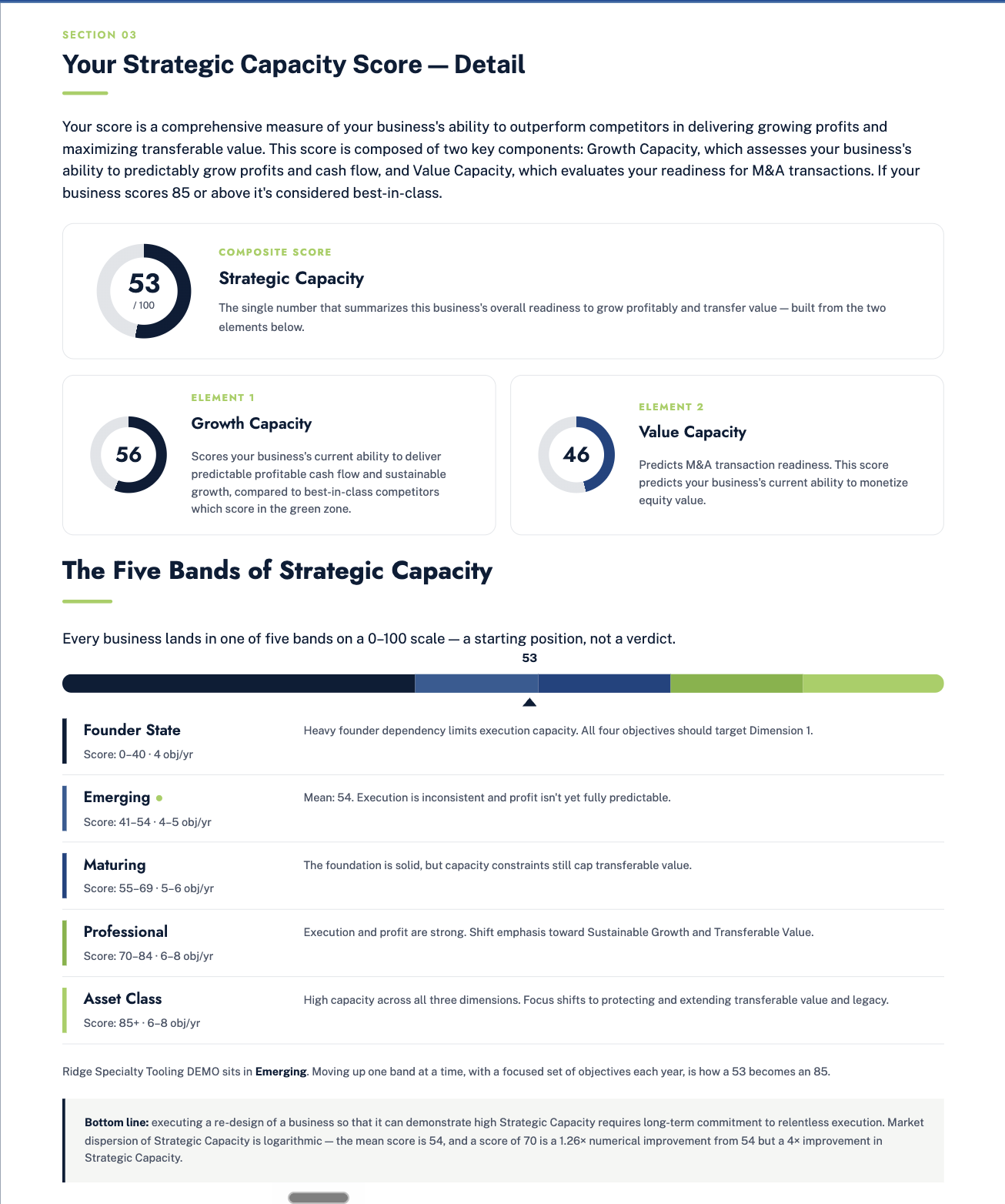
Strategic Capacity is a business's measurable ability to predictably and
sustainably grow profits, cash flows, and transferable equity value through proven
non-founder leadership, documented systems, scalable processes, and disciplined
financial management. It is quantified across twenty-four Growth-Driving Objectives
organized equally into the Three Dimensions of Business Growth: Predictable Profits
and Cash Flow, Predictable Sustainable Growth, and Predictable Transferable Value.
Any of these twenty-four objectives can represent a growth or deal killer. The
resulting score, from 0 to 100, places every business on a defined continuum from
Founder State through Asset Class. All scoring reflects a financial buyer's
perspective, not strategic or synergistic value.
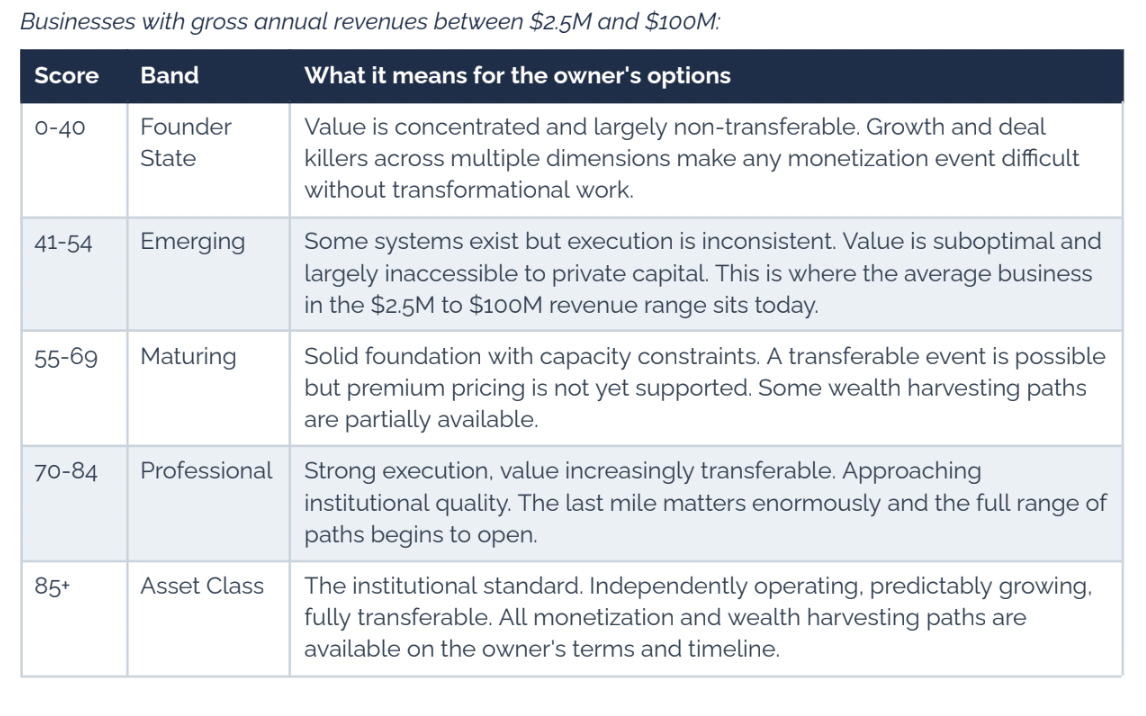
As the score decreases below 85, the predictability of future profitable growth
follows with it, and value becomes accessible only through increasingly constrained
means. A business at 54.1 is not halfway to Asset Class. It is in a structurally different condition. The growth and value gap is logarithmic: it compounds as the score gets lower, not with every year that passes, but with every point of distance from the institutional standard.
From Income Asset to Wealth Engine: What Asset Class Unlocks
Here is the conversation most business owners have never had: reaching 85+ does
not mean you have to sell. It means you have choices. For a client whose business is
significantly dependent on their presence and scoring near the 54.1 mean, there are
effectively two outcomes: keep working, or accept a suboptimal exit on a buyer's
terms. Neither reflects success from the personal or the professional perspective.
But here is what Strategic Capacity delivers. When the business operates
independently through proven leadership, documented systems, and disciplined
financial management, the owner's relationship with the business transforms. From
operator to owner. From constrained to optioned. From a single possible outcome to
a full menu of paths, selected on the owner's terms.
From Operator to Owner: Distributions, Chairman Role, and Growing AUM
At Asset Class, the owner can step back from operations entirely and begin drawing
distributions rather than a salary tied to personal production. Free cash flow converts
directly into investable assets, compounding inside the wealth plan the advisor
manages. Alternatively, the owner can transition to a chairman or shareholder role:
engaged in vision and governance, absent from execution, retaining full equity
upside while the senior leadership team runs the business. Both expressions of this
path deliver what a transaction cannot: the lifestyle the owner designed their
business to create, with the business continuing to grow beneath them. For the
wealth advisor, this is a multi-year AUM growth opportunity requiring no transaction
at all.
From Illiquid Equity to Diversified Wealth: Recapitalization
A minority equity sale or debt recapitalization converts a portion of illiquid business
equity into diversified wealth without a full exit. This path is partially available to
businesses below the Asset Class threshold, but the terms degrade materially as the
score drops. A lender or equity partner asks the same question any buyer asks: can
this business generate predictable cash flow independently? At 85, the answer is yes with evidence, and institutional quality pricing follows. At 54, the answer is
uncertain, and the capital reflects that uncertainty in structure, rate, and control
provisions.
From Hope to Evidence: Third-Party Sale
The conventional exit, executed from a position of maximum leverage. An Asset
Class business enters the market with a documented Strategic Capacity Score, a
Transferable Equity Value calculation, and a Readiness Roadmap. Asset Class
businesses consistently achieve three or more additional turns at the deal table
compared to businesses presenting similar financial metrics without the underlying
operational infrastructure. This path is technically available at any score, but the
difference between selling at 54 and selling at 85 is the difference between a buyer's
market and a seller's market.
From Aspiration to Execution: Sale to the Senior Leadership Team
Many business owners aspire to sell to the team that built the business alongside
them, and few execute it successfully. The obstacle is not motivation. It is that an SLT
buyout requires the buyer to service the purchase price from future free cash flow,
and the risk to that cash flow is precisely what most businesses at or below the
mean score cannot resolve. At 85, the business runs through systems and proven
leadership, the track record is documented, and the transaction is bankable. The
owner can be confident they will be paid from performance that does not depend
on their continued presence.
| The 85+ score is not an exit credential. It is an optionality credential. And the wealth advisor who helps a client understand that distinction is delivering something genuinely irreplaceable. |
The Planning Agenda the Analysis Opens
The Strategic Capacity assessment is the entry point into a multi-year planning
engagement that generates immediate value across every service line a wealth
advisor offers. This is the essence of what the Business Enterprise Institute calls
Owner-Based Planning (exitplanning.com/topics/owner-based-planning/): a
comprehensive framework anchored in the owner's personal goals and the specific
gaps the assessment surfaces. The gap between what the business is formally valued at and what it will actually transfer for is often the largest hole in the client's
financial picture. The assessment makes that hole visible. What follows is a concrete
planning agenda.
Advanced wealth planning becomes actionable the moment the Transferable Equity
Value calculation is in hand. The Value Gap, the difference between what the
business could be worth and what it will actually transfer for today, reframes every
other element of the wealth plan: retirement modeling, estate planning, tax strategy,
and liquidity planning all shift when the largest asset in the picture finally has honest
numbers attached to it.
Sophisticated compensation planning is surfaced directly by the assessment. When
senior leadership alignment scores below standard, the analysis has identified a
retention risk and a structural barrier to every monetization path. Equity participation
plans, deferred compensation structures, and performance-based incentive design
are the instruments that close that gap, and the wealth advisor who can speak to
their design is immediately valuable in a domain that compounds the client
relationship for years.
Succession planning, whether the goal is a chairman transition, an SLT buyout, or a
clean third-party sale, is the multi-year development of the operational
infrastructure that makes any path possible. The assessment provides something
succession planning conversations almost always lack: a quantified,
dimension-by-dimension picture of where the gaps are and what needs to be built.
Sophisticated insurance product placement follows directly from what the analysis
surfaces. Any of the twenty-four Growth-Driving Objectives can represent a growth
or deal killer, and the assessment identifies which ones apply to this client's business
specifically. Key person life and disability coverage, buy-sell funding, business
continuation structures, and, for clients approaching the chairman transition,
premium financing and private placement life insurance for tax-efficient wealth
transfer: each of these is opened by what the assessment reveals, not by a generic
risk conversation.
The advisor who initiates a Strategic Capacity assessment receives a detailed map
of the planning work that needs to happen across the full range of the client's
financial life, without acting as a business advisor. Every gap is a conversation. Every
conversation is a planning opportunity. And the advisor who opens that conversation
becomes the most relevant professional in the client's life.
Why This Matters for Your Practice
Business owners in the $2.5M to $100M revenue range are not an infinite population
-data shows there are only approximately 650,000 qualifying entities. The advisors
who serve them well, at depth, across the full picture of their financial lives, build the
most defensible books in the industry. Is this you? Should it be? The Strategic Capacity Score gives a wealth advisor something concrete to deliver before a single account is opened: an independent, quantified picture of the client's most important financial asset, and a clear line from that picture to every financial goal they hold.
For the advisor with existing business-owning clients, the same assessment creates
a structured reason to have a new and different conversation: one that surfaces
operational realities the client knows are true but has never seen reflected in a
professional assessment, and that makes every element of the wealth plan more
relevant because the largest piece of the client's financial picture is finally in the
room.
The client who experiences their wealth advisor as genuinely invested in the
success of their business is the client who does not take calls from competitors. I
have spent my career watching the two most important financial relationships in a
business owner's life, the advisor and the business, fail to speak to each other.
Transactions, when they come, produce a number. And, horribly, more often than not
the transaction did not produce the success the client had imagined. Should you
step in and help -simply by educating your clients about risks and realities?
The mean Strategic Capacity Score of 54.1 is a starting point, not a judgment. Most businesses can move meaningfully along the continuum with focused advisory engagement. The advisor who initiates the assessment, builds the planning agenda around what it surfaces, and stays engaged through the journey repositions themselves in their client’s mind from providing an add-on service to providing the most consequential financial guidance a business-owning client can receive.
This is your role. And it is, in my view, the most important opportunity in wealth
advisory today.
References
1. Business Enterprise Institute. Owner-Based Planning Framework. BEI, Denver CO.
exitplanning.com/topics/owner-based-planning/
2. Exit Planning Institute (2023). 2023 National State of Owner Readiness Report.
3. Garrison, Mike. Can I Borrow Your Car?: How Successful Financial Advisors Grow Their Business and
Love Their Life. 2022. Available on Amazon.
4. Sandmann, George. The Growth-Driving Advisor: Proven Strategies for Leading Businesses from
Stuck to Best-in-Class. Forbes Books, 2023. Available on Amazon.
5. Sandmann, G. and Weavill, A. (2025). Strategic Capacity as a Fundamental Driver of Business Value
Creation. Growth Drive Holdings LLC dba Growth-Drive.
6. Sandmann, G. & Weavill, A. (2026). The Asset Class Standard: How Strategic Capacity Quantification
Improves Private Capital Market Efficiency. Growth Drive Holdings LLC dba Growth-Drive.
 George Sandmann, Founder: Oct 9, 2026, 12:14:23 PM
Something extraordinary is happening at Growth-Drive. And I want to give you a glimpse of where we’re headed.
 George Sandmann, Founder: Sep 3, 2026, 9:55:18 AM
For years, we have described Strategic Capacity as a business's ability to predictably and sustainably grow profits and cash flow. That definition...
 George Sandmann, Founder: Aug 28, 2026, 2:59:21 PM
Advising a business owner is about the best work we can do. The owner’s business is often their largest asset, primary source of income, greatest...