You're Not the Ai Expert. That's Actually the Point.
A note for Growth-Drive advisors on how to lead the Ai conversation with your CEO clients — and where to start.
4 min read
George Sandmann, Founder
:
June 5, 2026
A note for Growth-Drive advisors on how to lead the Ai conversation with your CEO clients — and where to start.
Do you think you should be talking with your clients about Ai? Heck yes. But many of us are worried about our direct relevance to this conversation…. If this is you, read on.
And let's get something straight before we talk about artificial intelligence.
Your job is not to be the Ai expert in the room. It never will be. You are a strategic advisor, someone who helps privately held business owners see their business clearly, prioritize what matters, and build the kind of Strategic Capacity that creates real, transferable value. You help the businesses you serve and their CEOs move from Founder State to 85+ Strategic Capacity Asset Class. That role doesn't change because Ai arrived. If anything, you just became more relevant.
What does change is the conversation you need to have with your clients, prospects and COIs today.
Let’s face it, most folks are using Ai like a fancy google. They haven’t yet moved to understanding Ai as a force multiplier, a planned and systematic tool that increases Strategic Capacity. A tool that can help generate market-leading revenue per employee.
Your CEO clients are being bombarded right now. Vendors are pitching Ai tools. Their CFO read something on a flight. Their competitor supposedly automated and it’s delivering wonders. Everyone has an opinion. Very few people have a framework.
But you? You have a framework.
Here’s the secret: Before you talk tools, talk structure. There is a super intuitive way to frame Ai's impact across any privately held business.
Category 1 — Human-Led. Some parts of the business will always be driven by people. Leadership, culture, strategic vision, legal governance, brand, innovation — these depend on trust, judgment, relationships, and accountability that no algorithm can replicate. Ai plays a supporting role here: research, drafting, analysis, monitoring. The human is always in charge.
Category 2 — Hybrid Human-Ai. This is where the real near-term opportunity lives. Ai can take on a meaningful share of the operational workload, think 30 to 70 percent, while humans retain strategic accountability. Sales process, marketing execution, financial forecasting, hiring pipelines, customer satisfaction systems: all of these are becoming genuinely Ai-augmented in ways that are available, affordable, and practical for middle-market businesses right now.
Category 3 — Ai-Led. Some objectives are process-heavy, rules-based, and highly measurable. This is the kind of work that agentic Ai systems can increasingly own end-to-end. We're talking about SOP management, recurring revenue lifecycle automation, market size research. The technology is moving fast... And for most middle-market businesses, jumping straight to fully autonomous Ai execution is getting ahead of the curve. The infrastructure, the data discipline, and the change management requirements aren't there yet.
Here is the honest truth about where we are in the Ai adoption cycle: Category 3 is coming, but it isn't here yet. It doesn’t yet have the reliability, scale, and is not on the shelf and ready to go for the kinds of businesses most of us serve. Chasing full automation before the foundation is ready is a fast way to waste money and create operational chaos.
Category 2 is where the action is.
There are twenty-four Growth-Driving Objectives (GDOs). Thirteen of these sit in the Hybrid Human-Ai category. These are objectives where the technology is mature enough to deploy, the ROI is measurable, and the human accountability structure is already in place to govern it. This last piece matters more than most people realize. Ai doesn't create accountability, it measure and perhaps amplifies whatever accountability already exists.
Bottom line: Businesses with strong Strategic Capacity will deploy Ai faster, with less risk, and with better outcomes. That's not a coincidence: this is the framework working.
The great news is that helping clients deploy Ai is done at the same tempo as all Strategic Capacity projects: through Sprints. Sprints that can be tracked in the weekly BusinessFlow™scorecard. Sprints with human accountability. Huzzah.
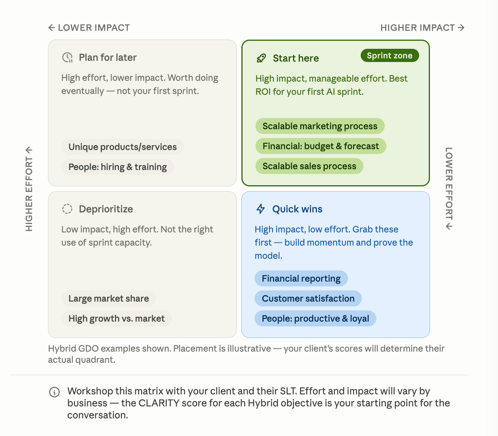
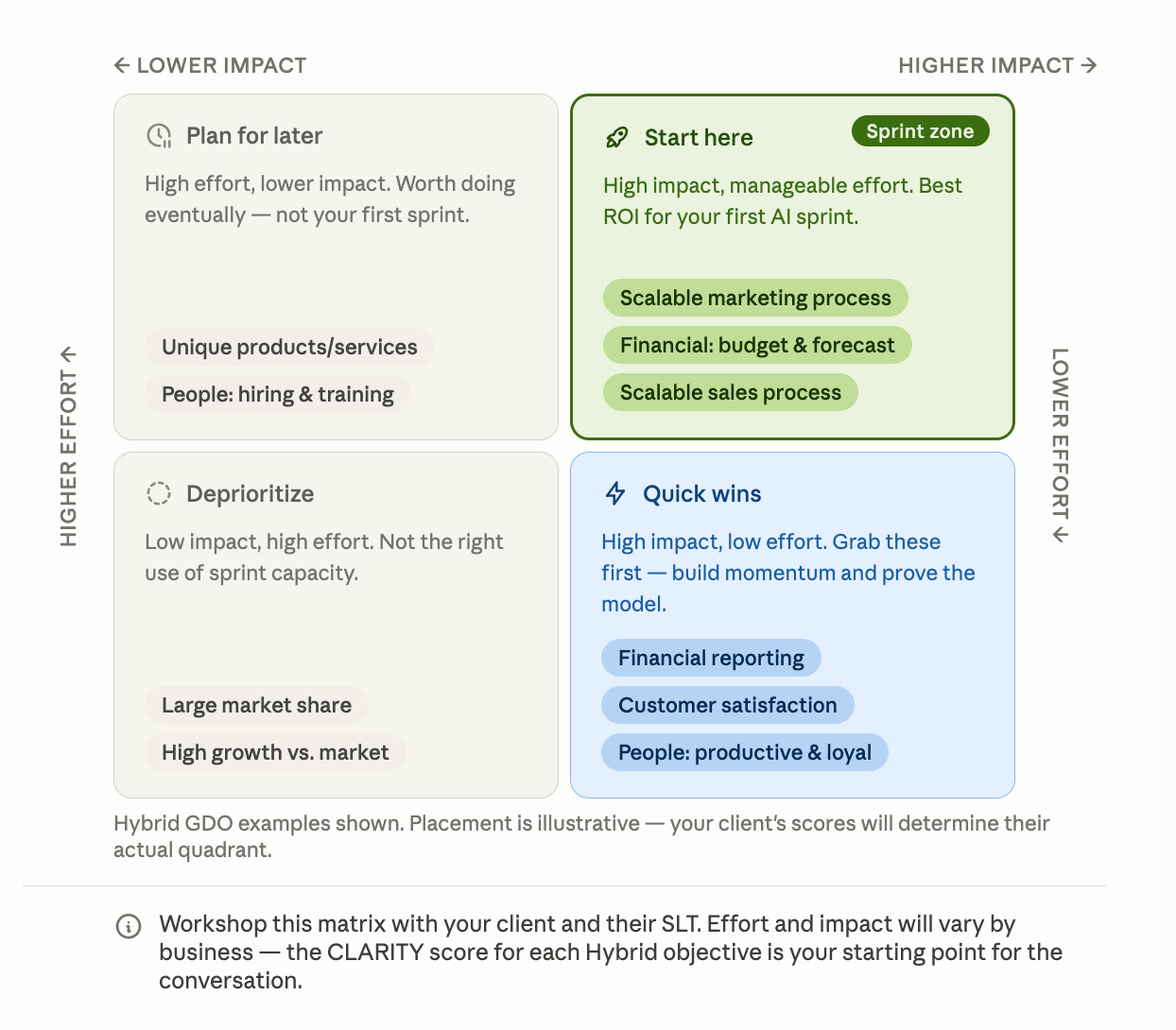
And you don't need to solve all thirteen Hybrid objectives at once (that would in fact be folly). You need to help your client identify one or two logical starting points: places where the operational pain is real, the data infrastructure is adequate, and a focused implementation sprint can produce a visible, measurable result.
That's where Ai subject matter experts (SMEs) come in. Your role is to identify where to focus and why it matters strategically. The implementation, the actual Ai tooling, the workflow design, the change management, belongs to specialists who do this work every day. You bring the strategic clarity. SMEs bring the technical execution. This is a collaboration, not a competition: This is the Integrated Doctrine in action, and you remain peer with the CEO.
Think of it as a sequenced process:
Rinse and repeat.
Graphic built using CLAIRE Ai. 
Listen Up: The businesses that get this right will not just be more efficient — they will be worth more. Analysis citing McKinsey's 2025 Global Ai Survey found that enterprises with mature AI programs reported 20–30% higher EBITDA growth versus sector peers over a two-year measurement window. For middle-market business owners thinking about exit timing and transferable value, that number deserves a moment of reflection. The question is no longer whether Ai will affect your business's value. It is whether your client will be on the right side of that gap when it matters. (Source: PhenomeCloud analysis of McKinsey 2025 Global AI Survey data)
To make this concrete for your CEO clients, we've mapped all 24 Growth-Driving Objectives (plus Bonus GDO 25) across the three categories. The charts on the following pages show you exactly which objectives are Human-Led, which are Hybrid, and which are approaching Ai-Led status over the next 12 to 18 months.
Use them as a leave-behind. Use them in your discovery conversation. Use them to show your client that you have a framework when everyone else is just making noise.
Because that's what Growth-Drive advisors do. We don't chase the shiny object. We ask the right question: where does this create Strategic Capacity — and how do we measure it?
The Ai Capability Forecast charts referenced above are available as a printable advisor resource in the Premium Resources of the Growth-Drive Community.
A note for Growth-Drive advisors on how to lead the Ai conversation with your CEO clients — and where to start.